
Skip to content
Home

Verified & updated:

Air Conditioner Size Calculator (BTU & kW)

Enter your room dimensions, ceiling height, insulation, and sun exposure to get the right cooling capacity in kW and BTU/h — plus estimated electrical draw and running cost.

Room type
m
m
m
ppl
Sunlight exposure
Insulation & floor level

Look for an air conditioner rated around 2.3 kW (8,000 BTU/h).

Your room needs about 7,000 BTU (2.1 kW) — stepping up to a 8,000 BTU (2.3 kW) unit handles peak afternoon heat without over-cycling.

Dual-Hose Portable AC

Recommended unit

2.3 kW

8,000 BTU

Calculated heat load

2.1 kW

83 W/m²

Floor area & volume

24.8 m²

59 m³

Est. draw & cost

~700 W

£0.91/8h · £27/mo

Scaled room & ceiling profile 5.5 m × 4.5 m
5.5 m 4.5 m 2.3 kW 24.8 m² 2.4 m Ceiling
Room footprint scaled proportionally alongside ceiling height compared against the 8 ft (2.4 m) baseline dashed line. Warm tint indicates high solar, attic, or kitchen heat load.

Step-by-step heat-load breakdown

24.8 m² ENERGY STAR baseline
2.1 kW (7,000 BTU)
Standard ceiling, sun, insulation & occupancy
±0 kW
Net cooling load
2.1 kW (7,000 BTU)
Recommended standard unit class
2.3 kW (8,000 BTU)

Power draw assumes a modern inverter unit (~COP 3.4 / CEER 11.5) running at 65% average compressor duty over 8 hours/day (at £0.25/kWh). Check the unit’s UK/EU energy label for exact wattage.

Room air conditioner sizing chart: BTU/h vs. kW cooling capacity

Baseline cooling capacities from U.S. EPA ENERGY STAR guidelines, converted to European kilowatt (kW) thermal output and approximate W/m² load density (assuming 8 ft / 2.4 m ceilings, average insulation, and two occupants).

Floor Area (Primary) Alternate Area Cooling Capacity Converted Capacity Load Density
9–14 m² 100–150 sq ft 1.5 kW 5,000 BTU ~130 W/m²
14–23 m² 150–250 sq ft 1.8 kW 6,000 BTU ~97 W/m²
23–28 m² 250–300 sq ft 2.1 kW 7,000 BTU ~82 W/m²
28–33 m² 300–350 sq ft 2.3 kW 8,000 BTU ~75 W/m²
33–37 m² 350–400 sq ft 2.6 kW 9,000 BTU ~74 W/m²
37–42 m² 400–450 sq ft 2.9 kW 10,000 BTU ~73 W/m²
42–51 m² 450–550 sq ft 3.5 kW 12,000 BTU ~75 W/m²
51–65 m² 550–700 sq ft 4.1 kW 14,000 BTU ~71 W/m²
65–93 m² 700–1,000 sq ft 5.3 kW 18,000 BTU ~67 W/m²
93–111 m² 1,000–1,200 sq ft 6.2 kW 21,000 BTU ~61 W/m²
111–130 m² 1,200–1,400 sq ft 6.7 kW 23,000 BTU ~56 W/m²
130–139 m² 1,400–1,500 sq ft 7.0 kW 24,000 BTU ~52 W/m²
139–186 m² 1,500–2,000 sq ft 8.8 kW 30,000 BTU ~54 W/m²
186–232 m² 2,000–2,500 sq ft 10.0 kW 34,000 BTU ~48 W/m²

Standard residential AC size classes: cooling output vs. typical electrical draw

1.5 kW 5k BTU ~450 W 1.8 kW 6k BTU ~530 W 2.3 kW 8k BTU ~700 W 2.6 kW 9k BTU ~780 W 2.9 kW 10k BTU ~880 W 3.5 kW 12k BTU ~1,050 W 4.1 kW 14k BTU ~1,240 W 5.3 kW 18k BTU ~1,580 W 7.0 kW 24k BTU ~2,100 W
Cooling capacity (BTU/h or kW thermal) is roughly 3× higher than electrical wall draw (watts) because heat pumps move heat rather than generating it. The highlighted bar marks a typical medium bedroom class.

Why buying a bigger AC makes your room feel clammy, not cooler

The most common air-conditioner buying mistake is rounding up two sizes "just to be safe." Cooling air temperature is only half of an air conditioner’s job — the other half is dehumidification, which happens only after the evaporator coil stays cold continuously for 10 to 15 minutes.

An oversized fixed-speed unit drops room temperature so fast that the thermostat shuts off the compressor within minutes (short-cycling). The air reads cool on the thermostat, yet relative humidity climbs past 60–65%, leaving sheets and air feeling damp and clammy while shortening compressor lifespan.
Beyond square footage: ceiling height, insulation, and west-facing glass

Standard sizing charts assume a 8-foot (2.4 m) ceiling and average wall insulation. In real homes, three architectural traits shift cooling demand dramatically:

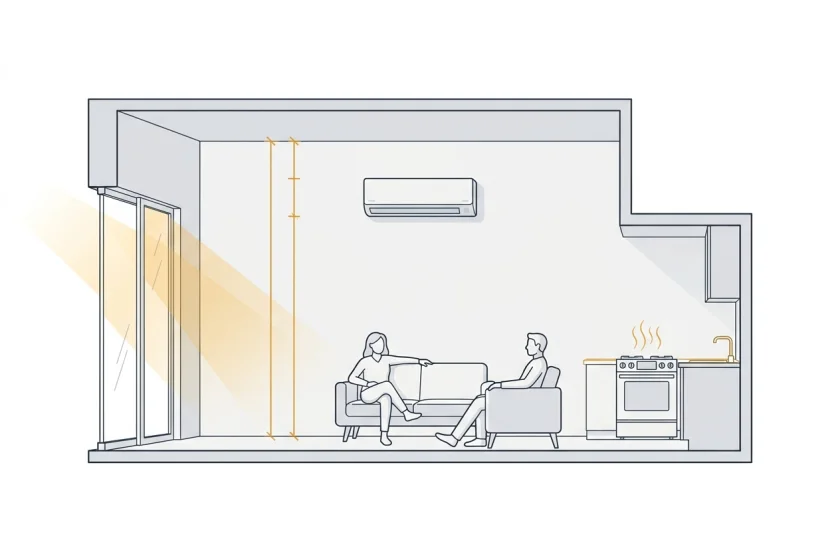
Cross-section diagram of residential room heat-gain sources: high ceilings, direct sunlight through windows, occupants, and kitchen appliances.
Four real-world heat sources that push cooling demand above a bare floor-area estimate: tall ceilings (+10%/ft above 8 ft), direct solar window gain (+10%), additional occupants (+600 BTU each), and kitchen heat (+4,000 BTU).
  • High or vaulted ceilings: Cooling air volume matters. Above 8 ft (2.4 m), every additional foot (~30 cm) adds roughly +10% air volume and vertical stratification heat.
  • Top-floor attics & older uninsulated masonry: Sun-baked roofs radiate heat well past sunset. Older homes with single-pane windows or uninsulated attics typically require 90–110 W/m² (+15% to +20% over baseline), whereas modern double-glazed passive-standard apartments often cool comfortably at 60 W/m² (−10%).
  • West-facing windows & kitchens: Low-angle afternoon sun through unshaded west glass easily adds 10% load; ovens, cooktops, and dishwashers warrant ENERGY STAR’s flat +4,000 BTU (+1.2 kW) kitchen allowance.
  • Open-plan doorways: If cool air spills freely down an open hallway or staircase without a door or thermal curtain, add 50% of the adjacent connected area to your calculation.

Window vs. Portable (Single-Hose & Dual-Hose) vs. Mini-Split: real BTU differences

Not all BTU ratings cool equally. Because portable air conditioners sit inside the conditioned room and exhaust hot air through hoses, the U.S. Department of Energy introduced the stricter SACC (Seasonally Adjusted Cooling Capacity) rating alongside older ASHRAE figures:

Real-world cooling efficiency & sizing advice by AC hardware category
AC Type Real Efficiency Noise at Ear Sizing Adjustment Rule
U-Shaped / Inverter Window AC High (CEER 12–15) Quiet (42–50 dB) Matches chart 1:1; keeps compressor outside glass
Standard Window AC Good (CEER 10.5–12) Moderate (50–56 dB) Matches chart 1:1; verify window width & sash clearance
Dual-Hose Inverter Portable Good (draws outdoor intake air) Moderate (48–54 dB) Size strictly by DOE SACC BTU (ignore inflated ASHRAE number)
Single-Hose Portable AC Low (creates negative pressure) Loud (52–60 dB) Draws warm hallway air back in; step up 1–2 brackets using SACC
Wall-Mount Mini-Split Highest (SEER2 18–26 / EU A+++) Whisper (19–30 dB) Best above 12,000 BTU (3.5 kW) or for European tilt-and-turn windows

BTU vs. kW thermal vs. electrical watts — and how to read CEER, SEER & EU Energy Labels

Shoppers frequently confuse cooling capacity in kW with electrical power draw in kW. A 3.5 kW (12,000 BTU/h) European split unit does not pull 3,500 watts from your wall socket — because a heat pump transfers ambient heat rather than burning electricity like a space heater, it draws only ~900 to 1,100 watts of electricity (a Coefficient of Performance / EER around 3.2–3.8).

To compare running costs cleanly across regions, look at CEER (Combined Energy Efficiency Ratio, standard on U.S. yellow EnergyGuide labels — higher is better, ENERGY STAR starts around 11–12+ for inverter models) or SEER and the A+++ to D EU Energy Label (Regulation (EU) 626/2011) on European split units. Upgrading from a CEER 9.5 portable to a CEER 14 inverter unit cuts electricity bills by roughly 32% for the exact same cooling output.

  1. 01. Find the unit’s rated cooling input watts (e.g., 950 W) or divide BTU/h by its CEER rating (12,000 ÷ 12.5 ≈ 960 W).
  2. 02. Multiply kilowatts by daily operating hours and typical 65% compressor duty cycle (0.96 kW × 8 h × 0.65 ≈ 5.0 kWh/day).
  3. 03. Multiply daily kWh by your local electricity tariff ($0.17 US avg, £0.25 UK, €0.35 DE, €0.25 FR, €0.18 ES) to see true summer operating cost.

Electrical circuits, window fit, and installation checks before ordering

Before clicking buy on any unit above 12,000 BTU (3.5 kW), check your wall outlet and circuit breaker. Standard North American 115V / 15A outlets safely carry up to ~1,440 W continuous load (covering almost all 5,000–12,000 BTU units), whereas 15,000–24,000 BTU window ACs typically require a 230V / 20A tandem-slot receptacle (NEMA 6-15 or 6-20).

In the UK and continental Europe, standard 230V / 13A–16A residential circuits handle plug-in portables comfortably, while fixed split systems above 2.5–3.5 kW legally require a certified F-Gas technician to connect refrigerant lines under EU F-Gas Regulation (EU) 2024/573.

Frequently asked questions

Under ENERGY STAR baseline rules (8 ft / 2.4 m ceiling, average shade and insulation), a 300 sq ft (28 m²) bedroom needs 7,000 to 8,000 BTU (2.0–2.3 kW). If the room has west-facing sun, a vaulted ceiling, or sits directly beneath a hot attic roof, step up to an 8,000–10,000 BTU inverter unit.

How this works

Baseline cooling load follows the official U.S. EPA ENERGY STAR room area brackets (calibrated for 8 ft / 2.4 m ceilings, average insulation, and 2 occupants), then applies volume, thermal-envelope, solar, occupancy, and kitchen appliance heat-gain modifiers before matching the next standard residential BTU/kW unit class.

Unit conversion
1 kW of cooling equals 3,412.14 BTU/h; 1 m² equals 10.76 sq ft (exact factor: 10.76391).
High ceiling adjustment
Above 8 ft (2.4 m), adds +10% to baseline BTU for each extra foot of ceiling height, capped at +60%.
Room & heat-gain modifiers
Adjusts baseline load by −10% / 0% / +15% for insulation and −10% / 0% / +10% for sun exposure, then adds +600 BTU/h per occupant beyond 2 and +4,000 BTU/h for a kitchen.
Daily electricity estimate
Rated watts divided by 1,000, multiplied by 8 hours/day at a 65% compressor duty cycle.
  • Single-hose portable buyers should compare the Net BTU result against the unit’s DOE SACC rating rather than inflated ASHRAE claims.
  • Whole-home central HVAC replacements require a room-by-room ACCA Manual J heat-gain audit including window orientation, duct losses, and local climate design temperatures.

Sources & standards

More Home tools

All tools

Related tools