
Skip to content
Sizing & Fit

Verified & updated:

Ring Size Chart, Converter & 1:1 Online Sizer

Convert ring sizes across UK (A–Z), US, EU/ISO, French, and Japanese scales in millimetres or inches—or calibrate your screen with any payment card to measure an existing ring at true 1:1 scale.

Size system
Band width
Measurement type
mm
Band width

Step 1 · Calibrate with a credit card

3.78 px/mm

Place any standard payment or ID card (ISO/IEC 7810 ID-1, 85.60 × 53.98 mm) flat against the dashed outline and slide until the borders match edge to edge.

85.60 × 53.98 mm

Step 2 · Place your ring over the circle

17.3 mm

Rest a well-fitting ring flat on the screen and adjust until the amber outline sits cleanly along the inside edge of the metal band.

UK N½

Matched Ring Size

UK N½

US 7 · UK N½ · EU/FR 54 · JP 14 · Ø 17.3 mm

Between sizes or prominent knuckle? You may also fit UK O (Ø 17.5 mm).

US / Canada

7

UK / AU

N½

EU (ISO 8653) / France

54

Japan

14

Inside Diameter

17.3 mm (0.68")

Circumference

54.4 mm (2.14")

International Ring Size Conversion Chart (US 3–13)

All millimetre figures follow ISO 8653 inside circumference (C = π × d), BS 6820 UK jeweller sizing (A–Z½), and US/Canada jeweller mandrels. Modern French ring sizes match ISO 8653 whole millimetres directly.

UK / AU US / Canada EU (ISO 8653) France Japan Inside Diameter Circumference
F 3 44 44 4 14.1 mm 44.2 mm
G 3.5 45 45 5 14.5 mm 45.5 mm
G½ 3.75 46 46 6 14.6 mm 46.0 mm
H 4 47 47 7 14.9 mm 46.8 mm
I 4.5 48 48 8 15.3 mm 48.0 mm
J½ 5 49 49 9 15.7 mm 49.3 mm
K 5.25 50 50 10 15.9 mm 50.0 mm
K½ 5.5 51 51 11 16.1 mm 50.6 mm
L½ 6 52 52 12 16.5 mm 51.9 mm
M½ 6.5 53 53 13 16.9 mm 53.1 mm
N½ 7 54 54 14 17.3 mm 54.4 mm
O 7.25 55 55 14.5 17.5 mm 55.0 mm
O½ 7.5 56 56 15 17.7 mm 55.7 mm
P½ 8 57 57 16 18.1 mm 57.0 mm
Q½ 8.5 58 58 17 18.5 mm 58.3 mm
R 8.75 59 59 18 18.8 mm 59.0 mm
R½ 9 60 60 19 18.9 mm 59.5 mm
S½ 9.5 61 61 20 19.4 mm 60.8 mm
T½ 10 62 62 21 19.8 mm 62.1 mm
U½ 10.5 63 63 22 20.2 mm 63.4 mm
V 10.75 64 64 23 20.4 mm 64.0 mm
V½ 11 65 65 24 20.6 mm 64.6 mm
W½ 11.5 66 66 25 21.0 mm 65.9 mm
X½ 12 67 67 26 21.4 mm 67.2 mm
Y½ 12.5 68 68 27 21.8 mm 68.5 mm
Z 12.75 69 69 28 22.0 mm 69.0 mm
Z½ 13 70 70 29 22.2 mm 69.7 mm

At a glance: the most common women’s ring sizes fall between US 6 (UK L½, EU/FR 52, Ø 16.5 mm) and US 7 (UK N½, EU/FR 54, Ø 17.3 mm), while the most common men’s sizes cluster around US 9 (UK R½, EU/FR 60, Ø 18.9 mm) to US 10 (UK T½, EU/FR 62, Ø 19.8 mm).

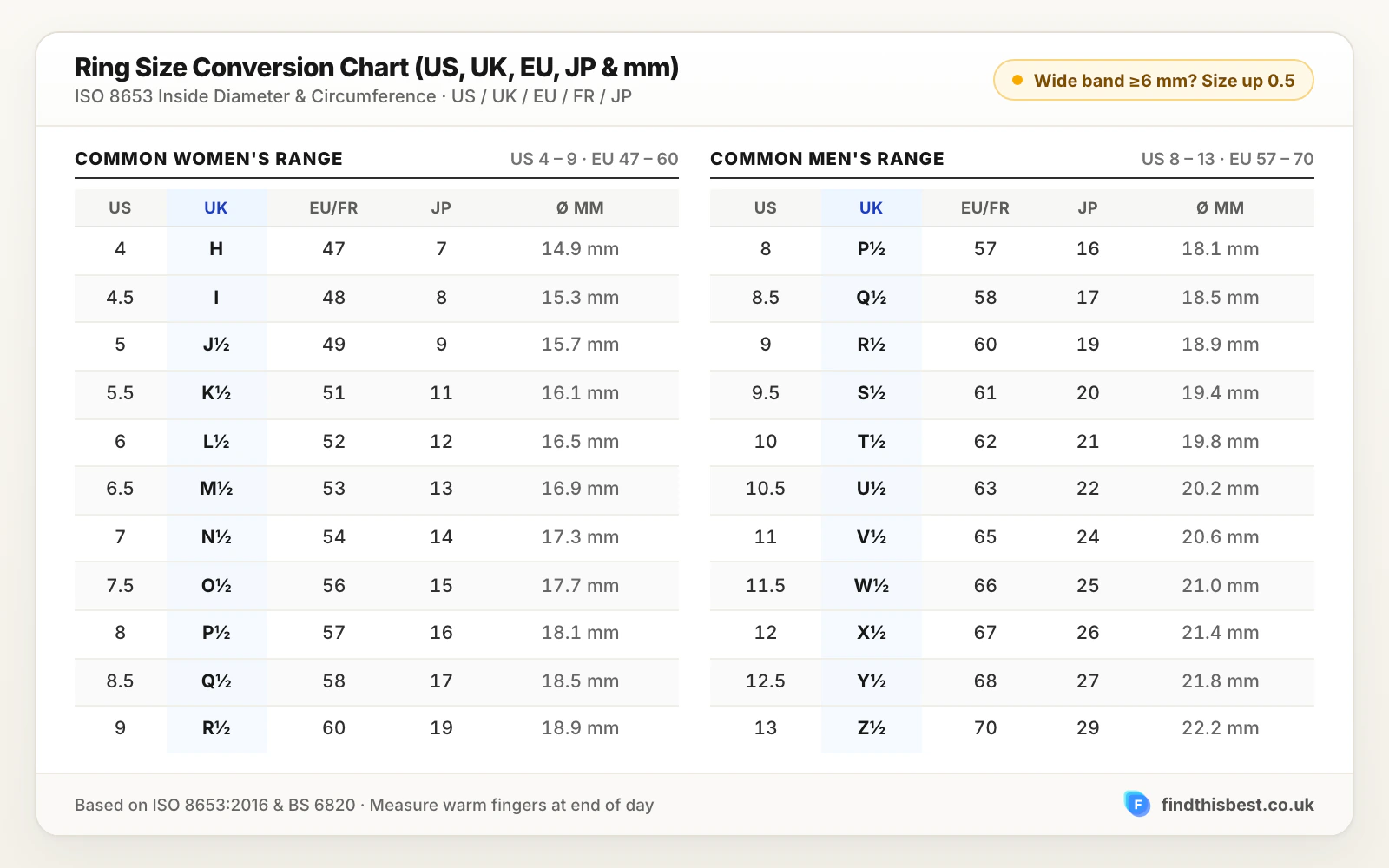
Quick-reference chart image

Ring Size Conversion Chart (US, UK, EU, JP & mm)

ISO 8653 millimeter conversion chart covering US 4–13, UK H–Z½, EU/FR 47–70, and Japanese sizes.

Download PNG

How to Measure Your Ring Size Accurately at Home

A single millimeter of inner diameter error moves your ring size by more than a full US size. For the most reliable home reading, measure an existing ring that already fits the exact finger you plan to wear the new ring on, rather than guessing from a stretchy piece of string.

  1. 01. Measure at room temperature in the evening: Fingers swell by up to half a size in warm weather, after exercise, or late in the day. Cold morning hands routinely under-measure.
  2. 02. Check the target hand explicitly: Your dominant hand is typically 0.5 size larger than your non-dominant hand—do not assume your right ring finger matches your left.
  3. 03. Use non-stretch paper, never yarn or twine: Cut a 5 mm strip of printer paper, wrap snugly around the base of your finger, verify it slides over the knuckle with gentle resistance, mark the overlap, and read the length in millimeters against a ruler.
  4. 04. Verify with our 1:1 calibrated screen sizer: If you own a comfortable ring, calibrate Step 1 against a physical credit card (85.60 mm wide) and match the inner edge of the metal band—not the outer rim.


Wide Bands (≥6 mm), Comfort Fit, and Prominent Knuckles

Narrow rings (2–4 mm) contact a small band of soft tissue and slip easily over the joint. Wide wedding bands, cigar bands, and stacked sets displace more skin as they slide on, creating noticeably tighter friction.

  • 6 mm to 8 mm bands: Go up 0.5 US size (or +1 EU millimeter) from your narrow-band size; enable the Wide toggle in the calculator above to preview this automatically.
  • 9 mm+ extra-wide or stacked rings: Go up 0.5 to 1.0 full US size depending on whether the inner profile is flat or domed.
  • Comfort-fit (court-profile) interiors: A rounded inner wall glides over knuckles more smoothly than a flat pipe-cut interior, often letting wide comfort-fit rings stay closer to your true size.
  • Knuckle larger than finger base: Size for the knuckle so the ring passes safely, then consider sizing beads inside the bottom shank to stop top-heavy stones from spinning.

Smart Ring Warning: Oura Ring Gen 4 vs. Samsung Galaxy Ring

Smart rings do not match standard US jewelry sizes 1:1. Recessed optical PPG sensors, rigid titanium shells (which cannot be resized by a jeweler), and all-day wear on the index or middle finger mean you should never order a smart ring solely from a standard engagement-ring chart.

Official smart ring sizing profiles compared with standard jewelry bands
Smart Ring Available Sizes Inner Sensor Profile Recommended Sizing Method
Oura Ring Gen 4 Whole sizes 4–15 (no half sizes) Recessed flat optical sensors (smoother than Gen 3 bumps) Use the official Oura Gen 4 Sizing Kit (Gen 3 kits differ slightly); wear 24h on index/middle finger
Samsung Galaxy Ring Whole sizes 5–13 (no half sizes) Slightly concave exterior with raised inner optical domes Use the official Samsung Galaxy Ring Sizing Kit; sizes often run ~0.5–1 size smaller than US jewelry
Standard Metal Band US 3–13 in 0.5 steps (EU 44–70) Uniform smooth circular bore (resizable for gold/platinum) ISO 8653 caliper, 1:1 calibrated screen sizer, or jeweler mandrel

Understanding US, UK, EU (ISO 8653), French, and Japanese Scales

EU & ISO 8653 (Germany, Spain, Europe)

ISO 8653 defines ring size directly as the inner circumference in millimeters (for example, size 54 = 54.0–54.4 mm circumference). Some German jewelers also quote inner diameter directly (17.3 mm = size 54).

France (Modern ISO vs. Legacy -40 Scale)

Modern French jewelers use the exact ISO 8653 millimeter figure (52, 54, 56). Vintage French listings occasionally subtract 40 (listing ISO 54 as 14)—simply add 40 to convert legacy French numbers to EU/ISO.

UK, Ireland & Australia (BS 6820 A–Z)

British and Australian sizes advance alphabetically from A to Z+6 in roughly 0.4 mm diameter steps (~0.5 US size per letter). Half letters (such as N½ for US 7) sit midway between full letters.

Japan & East Asia (JIS)

Japanese whole numbers run from 1 to 30 with ~0.33 mm diameter increments—roughly one third of a millimeter per step, giving finer whole-number granularity than US sizes.

Frequently asked questions

A US size 7 equals UK N½, EU/FR 54, and Japan 14, with an inside diameter of 17.3 mm and an inside circumference of 54.4 mm.

How this works

Conversion rows derive directly from ISO 8653:2016 (inner circumference in whole millimeters, C = π × d), standard US/CA mandrel steps (d = 11.63 + 0.8128 × US), UK BS 6820 alphabetic equivalents, and Japanese JIS inside diameters. The on-screen sizer calibrates CSS pixels per millimeter using the universal ISO/IEC 7810 ID-1 bank card reference (85.60 × 53.98 mm).

Brand names, trademarks, and icons are used for sizing identification only; this independent reference guide is not affiliated with or endorsed by any listed brand.

Sources & standards

More Sizing & Fit tools

All tools