Best Quantitative Filter Paper of 2026

* We independently evaluate all recommended products and services. If you click on links we provide, we may receive compensation.
Quantitative filter paper is an essential tool used in laboratories to separate solids from liquids. It is a type of filter paper that is designed to retain fine particles and allow the liquid to pass through. These papers are commonly used in analytical chemistry to isolate and weigh solids for further analysis. They are also used in environmental testing, food testing, and pharmaceuticals. Quantitative filter paper comes in various sizes and grades, and its selection depends on the type of sample being filtered and the desired filtration rate.
At a Glance: Our Top Picks
 #TOP 1
 9.8
9.8
 #TOP 2
9.7
#TOP 2
9.7
 #TOP 3
9.5
#TOP 3
9.5
Top 5 Quantitative Filter Paper
Whatman 1001-042 Quantitative Filter Paper Circles
The Whatman Filter Paper Circles are designed for a variety of laboratory applications, making them an essential tool for your tasks. With a diameter of 42.5 mm and a flow rate of 10.5 seconds per 100 mL, these Grade 1 circles are perfect for clarifying liquids, ensuring you achieve accurate and reliable results. Their versatility extends to the food industry, agriculture, and even air pollution monitoring, catering to diverse needs. Additionally, they are widely used in educational settings, aiding in the teaching of qualitative analytical separations.
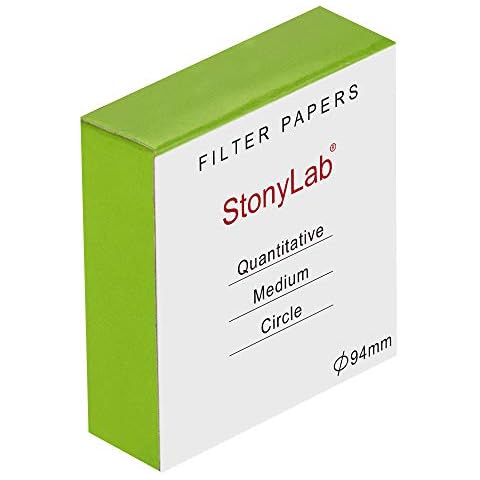
StonyLab 94mm Quantitative Filter Paper Circles
The StonyLab Filter Paper is designed with a 94mm diameter, making it ideal for various filtration tasks. Its coarse cellulose material effectively removes particles larger than 20 microns, ensuring clean results for your experiments. You will benefit from a filtration speed of 35 to 70 seconds, allowing for efficient processing without unnecessary delays. Additionally, the low ash content of ≤0.01% means you can trust that the filter will not introduce contaminants into your samples.
Whatman 1442-150 Ashless Quantitative Filter Paper 15cm
The Whatman 1442-150 Filter Paper is made from high-quality cotton fibres produced in dust-controlled rooms, ensuring cleanliness and reliability for your lab work. Its high purity makes it suitable for a wide range of critical applications where contamination must be avoided. With an ash content of just 0.007 percent, you can trust it to leave minimal residue, which is essential for accurate quantitative analysis. This filter paper offers consistent performance, helping you achieve precise and dependable results in your filtering tasks.
StonyLab 100 Pack Filter Paper Circles

The StonyLab Filter Paper is designed for effective filtration with a diameter of 56 mm. It removes particles larger than 10 microns, ensuring your samples remain pure and free from contaminants. With a filtration speed of 70 to 140 seconds, you can quickly process your liquids without unnecessary delays. The ash content is minimal, at just 0.01%, which means you can trust its reliability in quantitative analysis. These filter paper circles are also compatible with StonyLab's Buchner Filtering Funnel for added convenience.
Whatman 1441-055 Filter Paper Circles, 20 Micron

The Whatman Filter Paper Circles are made from high-quality cotton fibres in controlled dust environments, ensuring a clean filtration process. With a high purity level, these filters are ideal for a variety of critical applications, providing you with reliable results every time. The ash content is a mere 0.007 percent, which means you can trust that your samples remain uncontaminated. This makes them a perfect choice for anyone needing accurate and dependable filtration in their work.

Frequently Asked Questions (FAQs)
1. What is the quantitative filter paper?
Quantitative Filter Papers/ Hardened Filter Papers are used for quantitative and gravimetric analyses where the precipitate is to be recovered, as well as for pressure or vacuum filtration. Qualitative Filter Papers are used for qualitative analytical techniques to separate, determine and identify materials.
2. What's the difference between quantitative and qualitative filter paper?
The main difference between quantitative filter paper and qualitative filter paper is the amount of ash produced after ashing. Qualitative filter paper does not exceed 0.13%, quantitative filter paper does not exceed 0.0009%.
3. Which type of filter papers are used for accurate quantitative analysis?
Quantitative filter paper, also called ash-free filter paper, is used for quantitative and gravimetric analysis. During the manufacturing, producers use acid to make the paper ash-less and achieve high purity.
4. What are the different types of filter paper?
Generally, the filter paper types are qualitative filter paper and quantitative filter paper. The qualitative filter paper is often used in qualitative analysis. The reason is that the qualitative filter paper produces more cotton fibers if it is filtered.
During our quantitative filter paper research, we found 53 quantitative filter paper products and shortlisted 5 quality products. We collected and analyzed 5,699 customer reviews through our big data system to write the quantitative filter paper list. We found that most customers choose quantitative filter paper with an average price of £20.00.
The quantitative filter paper are available for purchase. We have researched hundreds of brands and picked the top brands of quantitative filter paper, including Whatman, stonylab.
Kenneth Collin graduated from Imperial College, London, at 22. He is a UX/UI designer, a web developer, and a writer, amongst others. At age 14, Kenneth programmed his first app. Kenneth's app served as a remote control for censored devices. "When I was 8, I would pick up scraps from electronics and try to rebuild or at least fix them," Kenneth said in one of his recent articles on Home repairs for top gadgets.