Best Motor Contactors of 2026

* We independently evaluate all recommended products and services. If you click on links we provide, we may receive compensation.
Motor contactors are essential components in electrical circuits that control the operation of motors. They are designed to switch on and off the power supply to the motor, providing a safe and reliable means of starting, stopping, and reversing the motor's direction. Motor contactors are available in a range of sizes and configurations to suit different types of motors and applications. They are widely used in industrial, commercial, and residential settings to ensure the smooth and efficient operation of motors and to protect them from damage due to overload or other faults.
At a Glance: Our Top Picks
 #TOP 1
 9.8
9.8
 #TOP 2
9.7
#TOP 2
9.7
 #TOP 3
9.5
#TOP 3
9.5
Top 6 Motor Contactors
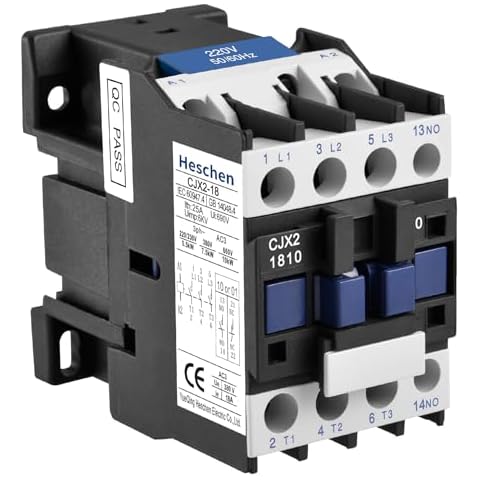
Heschen CJX2-1810 3 Pole AC Contactor
The Heschen CJX2-1810 is a reliable AC contactor designed for efficient motor control. With a rated coil voltage of 220V and a frequency of 50/60Hz, it ensures reliable operation for various electrical applications. Its robust specifications include a current rating of 18A, making it suitable for heavy-duty tasks. Additionally, the contactor is designed for easy rail mounting on a standard 35 mm DIN rail, providing convenience during installation. Its compact size of approximately 87 x 47 x 76 mm means it can fit into tighter spaces without hassle.
Heschen HS1-25 Household AC Contactor
The Heschen HS1-25 Contactor is designed for household use with a coil voltage of 220V/230V and a rating of 25 Amps. This device features a 1NO 1NC contact type with two poles, ensuring versatility in controlling various electrical applications. Its compact size of approximately 82x65x18 mm makes installation on a 35 mm DIN rail straightforward and efficient, providing a neat solution for your electrical projects. By using this contactor, you enhance the reliability of your electrical system while simplifying your wiring tasks.
Heschen MC-12b Magnetic AC Motor Contactor
The Heschen MC-12b Contactor is an efficient solution for controlling AC motors. With a current rating of 25A and a voltage capacity of up to 690V, it ensures reliable performance in various applications. Its compact dimensions of 45 x 73 x 88mm make it easy to install on a DIN rail, saving space in your setup. Weighing just 346g, the product is lightweight yet sturdy, making it ideal for both industrial and domestic use.
Heschen CJX2-1210 AC Contactor 3P 12A 380V

The Heschen CJX2-1210 Contactor is designed to handle a rated voltage of 380V and a current of 12A, making it suitable for controlling electrical motors and circuits safely. With a coil voltage of AC 24V and a frequency range of 50/60Hz, it offers flexibility for various power supply conditions. The contactor is built to fit a standard 35 mm DIN rail, ensuring easy installation in your electrical panels. Its compact size of approximately 82 x 47 x 76mm means it won’t take up much space, helping you keep your setup neat and organised.
Heschen CT1-63 Household AC Contactor

The Heschen AC Contactor is designed for household use, operating at a voltage rating of 220V/240VAC and capable of handling up to 63 amps. With its two normally open (NO) poles, this device allows for efficient control of electrical circuits, ensuring smooth operation of your appliances. It is easy to mount on a 35 mm DIN rail, providing a neat and organised installation. Weighing only 243g, it is lightweight and easy to handle, making it convenient for both new and experienced users.
KEDU JD3 400V 50Hz Motor Contactor with 4 NO Contacts
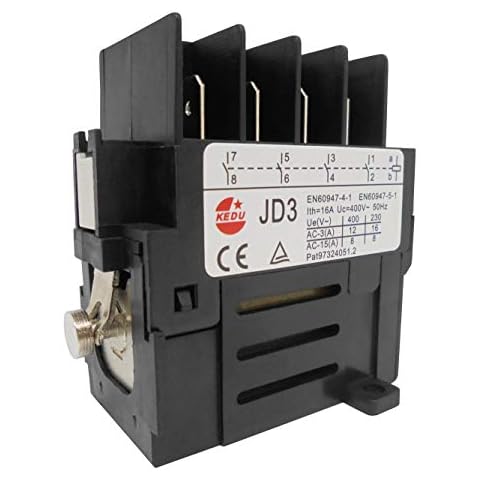
The KEDU JD3 Motor Contactor is a versatile and reliable component for your electrical applications. With four normally open (NO) contacts, it provides enhanced safety protection, ensuring that your devices operate reliably. The quality-tested design means that you can trust its performance, as all products are TÜV certified. Additionally, if you encounter any issues, repairing your faulty KOA magnetic switch is straightforward with this spare part, making it a convenient choice for users.

Frequently Asked Questions (FAQs)
1. Why are contactors used in motor control?
Why are Contactors Used? Contactors are used for high power applications. They allow a lower voltage and current to switch a much higher power circuit, so they are generally larger and more heavy-duty than control relays, enabling them to switch higher power loads on and off for many thousands of cycles (Figure 1).
2. What are the different types of contactors?
There are different types of contacts in a contactor, and they are; auxiliary contact, power contact, and contact spring. The power contact has two types that are; stationary and movable contact. Material for making contacts must have a high welding resistance and stable arc resistance.
3. What is the difference between motor starters and contactors?
A Motor Starter is a basically a contactor with the addition of an overload relay which will drop out the coil voltage in case of motor overload condition. A Contactor is an electrically control switch same as a relay. It is used for switching the current to ON and OFF a circuit.
4. What is the difference between contactor and circuit breaker?
An electronic contactor is a simple switching device, whereas the circuit breaker is a protective system. The primary function of a contactor is controlling the power. A circuit breaker does the protecting. Contactor works under normal situations.
During our motor contactor research, we found 306 motor contactor products and shortlisted 6 quality products. We collected and analyzed 12,043 customer reviews through our big data system to write the motor contactors list. We found that most customers choose motor contactors with an average price of £16.04.
The motor contactors are available for purchase. We have researched hundreds of brands and picked the top brands of motor contactors, including Heschen, sys2sell.
Harvey Wall was born and raised in Norwich. He mastered the art of tool production and finished at the prestigious Norwich University. His area of interest include cutting tools, abrasive finishing and power tools. Harvey is always looking for ways to improve the finesse of industrial tools via his myriads of researches. He also shares some of his experiences on many platforms while writing on tool products.