Best Flexible Beam Couplings of 2026

* We independently evaluate all recommended products and services. If you click on links we provide, we may receive compensation.
Flexible beam couplings are mechanical devices that connect two shafts together, allowing for the transmission of torque and rotational movement. These couplings are designed to compensate for misalignments between the shafts, which can occur due to factors such as vibration, temperature changes, and manufacturing tolerances. They are typically made of materials such as stainless steel or aluminium, and are used in a wide range of applications, including robotics, aerospace, and automotive industries. Flexible beam couplings are known for their durability, reliability, and ability to transmit power efficiently.
At a Glance: Our Top Picks
 #TOP 1
 9.8
9.8
 #TOP 2
9.7
#TOP 2
9.7
 #TOP 3
9.5
#TOP 3
9.5
Top 3 Flexible Beam Couplings
TOP-VIGOR 6mm to 6.35mm Flexible Coupling
The TOP-VIGOR Flexible Coupling is designed for seamless connection between shafts, accommodating sizes from 6mm to 6.35mm. Its good flexibility alleviates stress, ensuring smooth operation between the motor and driving components. With excellent adaptability, it efficiently absorbs misalignments and shaft end-play, making it ideal for various applications. This coupling is particularly useful in small CNC machines and 3D printers, providing reliable performance and enhancing the overall functionality of your projects.
sourcing map 2PCS 6.35mm to 10mm Helical Beam Coupler
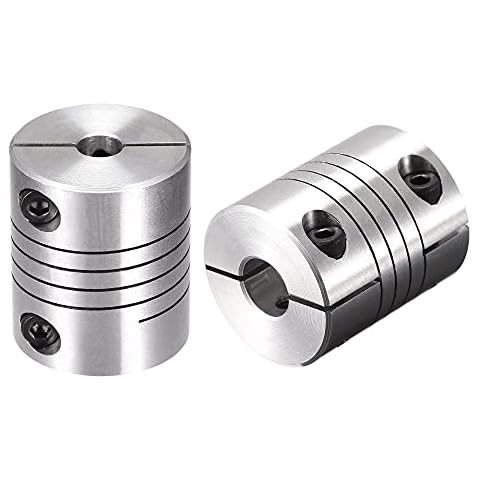
The sourcing map Helical Beam Coupler is designed to provide zero backlash thanks to its two-piece metallic spring construction. This feature ensures a secure connection between shafts, making it ideal for light to medium torque applications. The coupler is made from durable aluminium alloy, ensuring longevity and reliability. Additionally, it effectively absorbs parallel and angular misalignments, which can help maintain the efficiency of your drive systems and minimise wear on components.
TOP-VIGOR 8mm Aluminium Plum Flexible Coupler
The TOP-VIGOR Plum Coupler is a versatile power transmission coupling designed to efficiently transmit torque while reducing vibrations, helping to protect your equipment from damage. Its 8mm to 8mm shaft size and compact dimensions make it suitable for various motion control applications. Made from high-strength aluminium alloy, this flexible coupler offers durability and a long service life without the need for lubrication, making it both convenient and quiet to use. Widely compatible, it connects easily to servo motors, step motors, and other mechanical devices, providing reliable and stable performance.

Frequently Asked Questions (FAQs)
1. What is beam coupling?
A beam coupling, sometimes called a helical coupling, consists of a single piece of material made flexible by the removal of material in a helical pattern along its length.
2. What are flexible couplings used for?
Flexible couplings are utilized to transmit torque starting with one shaft then onto the next when the two shafts are marginally misaligned. Flexible couplings can oblige fluctuating degrees of misalignment up to 3° and some parallel misalignment.
3. What is flexible coupling?
Introduction. The purpose of a flexible coupling is to transmit torque from one piece of rotating equipment to another, while accepting at the same time a small amount of misalignment. Flexible coupling misalignment is expressed, as an order of magnitude, in thousandths of an inch.
During our flexible beam coupling research, we found 46 flexible beam coupling products and shortlisted 3 quality products. We collected and analyzed 2,241 customer reviews through our big data system to write the flexible beam couplings list. We found that most customers choose flexible beam couplings with an average price of £20.00.
The flexible beam couplings are available for purchase. We have researched hundreds of brands and picked the top brands of flexible beam couplings, including TOP-VIGOR, sourcing map.
Harvey Wall was born and raised in Norwich. He mastered the art of tool production and finished at the prestigious Norwich University. His area of interest include cutting tools, abrasive finishing and power tools. Harvey is always looking for ways to improve the finesse of industrial tools via his myriads of researches. He also shares some of his experiences on many platforms while writing on tool products.